Bikepacking Australia: The Complete Guide to Exploring Australia by Bike
Australia is one of those countries that looks deceptively simple on a map.
There are roads crossing almost every part of the continent, the terrain doesn’t appear particularly mountainous compared with many other famous bikepacking destinations, and there is an enormous amount of open space.
Then you start planning a bikepacking trip and realise that Australia plays by completely different rules.
Distances are enormous. Weather changes dramatically between regions. A road that looks perfectly manageable on a map can become slow, corrugated gravel for hundreds of kilometres. A town marked on a map may have little more than a roadhouse. A water source may be seasonal or unreliable. And in some parts of the country, being able to ride 150 kilometres in a day matters less than being able to carry enough water for the next 250.
That combination is precisely what makes Australia such a fascinating country to explore by bicycle.
You can ride through ancient forests in Western Australia, cross the mountains and high country of Victoria, follow remote tracks through the Outback, cycle between beaches and rainforest in Queensland, or spend weeks exploring Tasmania’s compact but rugged landscape.
You don’t need to cross the continent to experience the adventure.
In fact, for most people, choosing a smaller region and understanding it properly will result in a much better trip.
Best Bikepacking Itineraries in Australia
The table below brings together twelve of the most interesting routes and regions to consider. Each of them will be explored in a dedicated article, where we can go beyond the overview and look at the practical details that actually matter when planning the ride — route options, terrain, daily distances, water, resupply, camping, navigation, weather, logistics and the type of bike required.
For now, use this list to find the kind of Australian bikepacking adventure you’re looking for.
Each route deserves much more than a paragraph, though. We will explore them individually in dedicated guides, looking at the route itself, terrain and surfaces, difficulty, best season, water and resupply, camping, navigation, logistics, and what kind of bike and experience you need. This article is therefore the starting point: use the overview to decide which Australian adventure interests you, then follow the dedicated guide for the route you want to ride.
| Route | Region | Approx. difficulty | Surface | Best for |
|---|
| Munda Biddi Trail | Western Australia | Moderate–Hard | Mostly off-road | First serious Australian bikepacking trip |
| Tasmanian Trail | Tasmania | Hard | Mixed/off-road | Wilderness and variety |
| Mawson Trail | South Australia | Hard | Gravel/rough roads | Long-distance gravel |
| Victorian High Country | Victoria | Hard | Gravel/4WD tracks | Mountains and climbing |
| Great Victorian Rail Trail | Victoria | Easy–Moderate | Mostly gravel | Beginners and shorter trips |
| Brisbane Valley Rail Trail | Queensland | Easy–Moderate | Gravel/rail trail | Accessible bikepacking |
| Great Ocean Road + Otways | Victoria | Moderate | Road/gravel/trail | Coast + forest |
| South West WA | Western Australia | Moderate–Hard | Gravel/road/trail | Forest, coast and wine country |
| Gibb River Road | Western Australia | Very Hard | Rough gravel | Remote Outback adventure |
| Tanami / Central Australian routes | Northern Territory/WA | Extreme | Remote gravel | Experienced expedition riders |
| Tasmanian wilderness routes | Tasmania | Hard | Gravel/trail | Shorter wild adventures |
| Australian Alps / High Country routes | VIC/NSW | Hard–Extreme | Gravel/4WD tracks | Serious climbing and remoteness |
Why Bikepacking Australia?
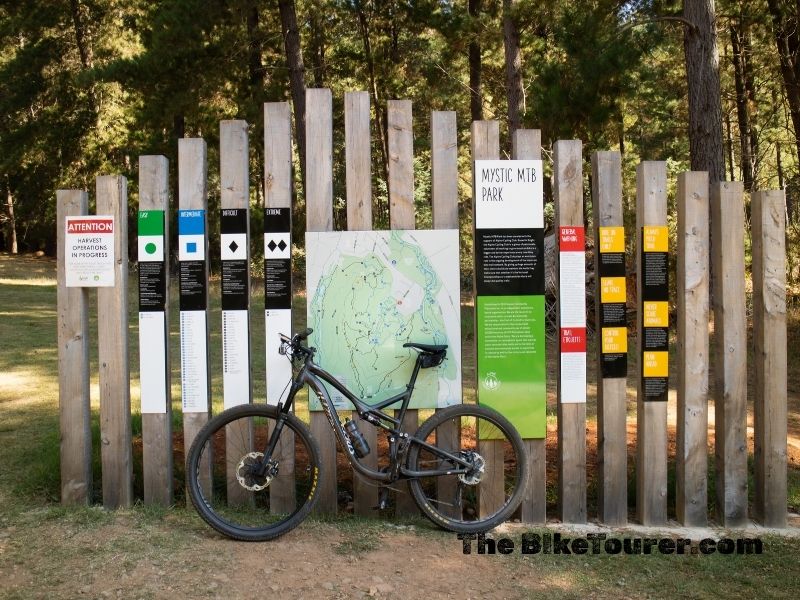
Australia is particularly well suited to the kind of travel that makes bikepacking appealing.
There is a huge variety of landscapes, relatively low population density outside the major cities, an extensive network of minor roads and tracks, and plenty of camp opportunities.
But the real attraction is the sense of scale.
In Europe, you can often ride out of one town and into another within a few hours. In Australia, you can spend an entire day riding through essentially the same landscape.
That changes the experience of travelling by bicycle.
A road doesn’t necessarily lead from one village to the next. It may lead to the next roadhouse 180 kilometres away.
A beautiful gravel track isn’t necessarily a recreational trail. It might be a working forestry road, a station road or an access track through extremely remote country.
And a route that looks like a straightforward line between two points may require several days of food and water.
This makes Australian bikepacking less about simply finding interesting roads and more about understanding the landscape you’re riding through.
Bikepacking or Bicycle Touring?
Australia is a particularly good place to blur the distinction between bikepacking and traditional bicycle touring.
A gravel bike with bikepacking bags might be ideal for one route. A mountain bike with larger luggage could be better for another. On long stretches of paved road, a traditional touring bike with panniers may actually be the more comfortable choice.
The terminology matters less than the route.
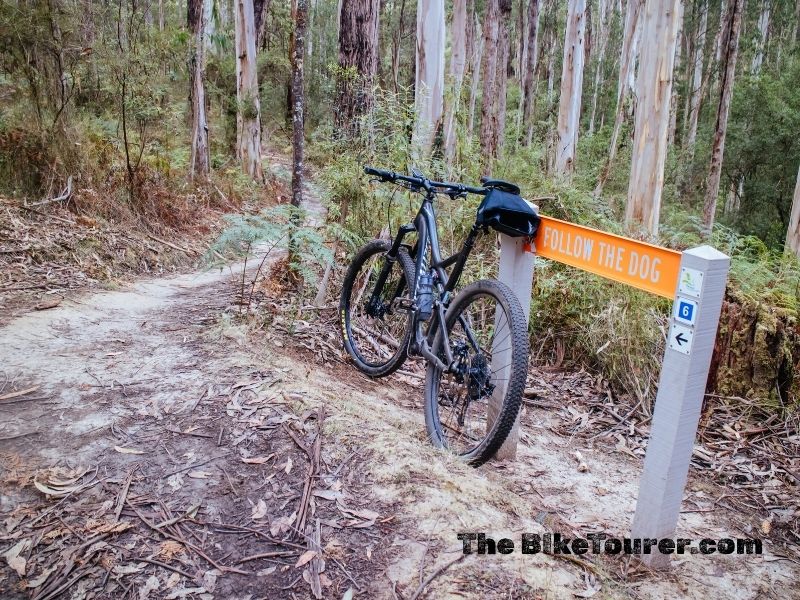
If you’re riding a dedicated off-road trail such as the Munda Biddi, lightweight bikepacking luggage can make sense.
If you’re spending several weeks crossing Australia and carrying camping equipment, food and large quantities of water, the additional capacity of panniers can become extremely useful.
There is no prize for carrying less luggage than necessary.
In remote Australia, having enough water and food is more important than having the lightest possible bike.
Understanding Australia’s Geography
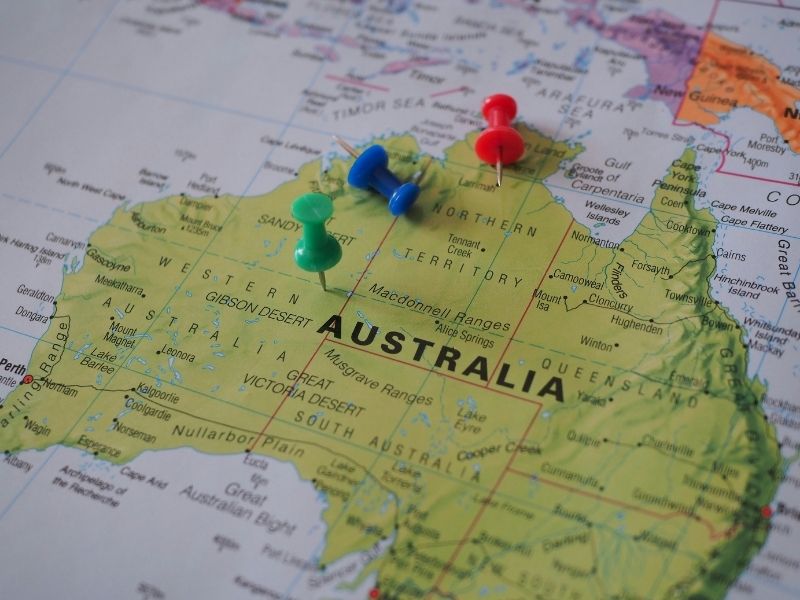
One of the biggest mistakes a first-time visitor can make is thinking about Australia as a single cycling destination.
It isn’t.
Australia contains several very different climatic and geographical zones, and your experience can change dramatically depending on where you ride.
The South
Tasmania, Victoria and southern New South Wales offer some of the most accessible bikepacking opportunities.
You will find mountains, forests, farmland, gravel roads, rail trails and established cycling routes. There are also considerably more towns and services than in the remote interior.
For someone travelling from Europe or North America and looking for their first Australian bikepacking experience, this is often the easiest place to begin.
The East Coast
The east coast has Australia’s largest concentration of population.
That doesn’t mean it is the easiest place to cycle. Major highways and urban areas can be unpleasant, while the more interesting routes often head inland into the mountains.
The Great Dividing Range creates a huge variety of terrain, from relatively gentle agricultural country to steep mountain roads and remote forest tracks.
The advantage is that you can often combine wilderness with relatively frequent resupply.
The Tropical North
Northern Queensland and the Northern Territory are governed by a very different climate.
Here, heat and humidity become major factors, while the wet and dry seasons can fundamentally change the feasibility of a route.
During the wet season, some roads and tracks can become extremely difficult or impassable.
During the dry season, conditions can be much more favourable, but temperatures can still be punishing.
Northern Australia also introduces additional considerations around crocodiles, tropical storms and water.
Western Australia
Western Australia is where Australia’s enormous scale really becomes apparent.
The south-west offers forests, coastal landscapes and some outstanding long-distance cycling routes, including the Munda Biddi Trail.
Further north, the distances between settlements increase dramatically.
The Kimberley and remote interior offer extraordinary landscapes, but these are not places where you should improvise your logistics after you arrive.
The Outback
The word “Outback” covers an enormous area and shouldn’t be treated as a single landscape.
Some Outback routes pass regularly through small communities and roadhouses. Others can involve several hundred kilometres between meaningful resupply points.
The critical question isn’t:
“Can I cycle this road?”
It is:
“Can I safely support myself while cycling this road?”
That distinction should influence every decision you make.
When Is the Best Time to Bikepack Australia?
There is no universal Australian bikepacking season.
Australia spans enough latitude that winter in Tasmania and winter in the Northern Territory can feel like completely different seasons.
Instead of asking when Australia is best, ask:
Where in Australia do I want to ride?
For southern Australia, spring through autumn can offer excellent conditions, although summer heat can become significant inland.
Tasmania is generally most attractive during the warmer months, when longer daylight hours and milder temperatures make remote riding easier.
In northern Australia, the dry season is usually the preferred period for outdoor adventures.
The shoulder seasons can be particularly interesting because they may offer a compromise between weather and tourist numbers, but they require more careful research.
Don’t Ignore Seasonal Extremes
Australian weather isn’t simply a question of whether it will rain.
Heat can be the dominant factor.
A cyclist accustomed to European summers may underestimate how quickly riding in extreme Australian temperatures can affect hydration and energy requirements.
The opposite can also happen in mountainous areas, where temperatures can fall dramatically at night.
Bushfires are another consideration in some regions during the hotter months.
Before riding a remote route, check not only the forecast but also:
- fire conditions
- road closures
- trail closures
- flooding
- recent rainfall
- water availability
- local warnings
Weather can turn a good route into a bad route surprisingly quickly.
How Far Can You Cycle in a Day in Australia?
Your usual daily distance is not necessarily a useful planning tool in Australia.
A cyclist who comfortably rides 100 kilometres on European roads might find 70 kilometres of corrugated gravel considerably harder.
Likewise, 100 kilometres of flat sealed road with a strong tailwind may be easier than 50 kilometres of soft sand, steep climbing or relentless headwind.
When planning a route, consider time rather than distance.
Ask yourself:
- How many hours will I actually be riding?
- What surface will I encounter?
- How much climbing is involved?
- How much luggage am I carrying?
- How much water do I need?
- How much heat will I be exposed to?
- What happens if I arrive late?
This becomes particularly important when campsites or water sources are separated by fixed distances.
A 60-kilometre day might be ambitious on one trail and trivial on another.
Gravel Changes Everything
Australia is a paradise for gravel riding, but gravel in Australia isn’t one thing.
You may encounter smooth hard-packed dirt that is almost as fast as asphalt.
You may also encounter corrugations: repetitive ridges across the road that can shake both rider and bicycle for hours.
Then there is loose gravel, deep sand, rocky surfaces and mud after rain.
The surface can have a bigger effect on your speed than the gradient.
This is why choosing a bike based simply on the route’s total distance is a mistake.
A 500-kilometre gravel route may require much more preparation than a 1,000-kilometre paved route.
Water: The First Thing You Should Plan
If you’re riding in a populated part of Australia, water is usually a manageable issue.
In remote areas, it can become the defining logistical problem of the entire trip.
The first question isn’t how much water you personally drink.
It’s:
How much water do I need between reliable opportunities to refill?
That includes drinking water, cooking water and an emergency reserve.
You also need to consider the reliability of the source.
A river marked on a map might be dry.
A rainwater tank might be empty.
A campsite might have water that requires treatment.
A shop listed online might be closed.
For this reason, experienced bikepackers often plan around known reliable sources, while treating everything else as a bonus.
Water Capacity Is Part of Route Planning
Don’t decide how much water to carry after choosing your bike.
Your required water capacity should influence the bike and luggage setup from the beginning.
A route with frequent towns might require only a few litres of additional capacity.
A remote route could require substantially more.
That extra weight then affects your tyres, wheels, handling, climbing speed and daily distance.
In other words:
Water changes the bike.
Food and Resupply
Food is generally easier to solve than water, but the same principle applies.
Don’t assume that every dot on Google Maps represents a functioning supermarket.
Small Australian communities may have:
- a general store
- a pub
- a roadhouse
- a petrol station
- a café
- no food service at all
Opening hours can also be limited.
If you’re riding through remote areas, check your resupply points in advance and carry enough food to cover unexpected delays.
A headwind that slows you down for a day, a mechanical problem or a road closure can turn a carefully calculated food supply into a problem.
This is why a remote bikepacking itinerary should always contain some margin.
Accommodation and Camping
Australia offers an enormous range of sleeping options.
Depending on where you’re riding, you may find:
- national park campsites
- private campgrounds
- caravan parks
- dedicated bikepacking shelters
- hostels
- hotels
- motels
- country pubs
- farm stays
- private accommodation
Camping is often the most natural choice for remote routes.
But don’t assume that wild camping is automatically legal just because the landscape appears empty.
Rules vary between states, national parks, forests and private land.
Check the regulations for the specific route.
Pub Packing
There is also a very appealing alternative to traditional bikepacking.
Instead of carrying camping equipment, you can design a route between towns and stay in country pubs, motels and other inexpensive accommodation.
This style of bicycle travel is sometimes called pub packing.
It reduces luggage considerably and can make longer-distance touring more accessible.
You won’t get the same wilderness experience as sleeping beside a remote trail, but you gain something else: a cold drink, a proper bed and the chance to meet people in small Australian towns.
For many riders, that’s a pretty good trade.
What Bike Should You Take?
There is no Australian bikepacking standard.
For a dedicated gravel route, a gravel bike with wide tyres may be ideal.
For rougher trails and sandy sections, a mountain bike can offer considerably more control.
For long road-heavy tours, a touring bike may be the better tool.
If you’re travelling internationally, there is also a practical question:
Should you bring your own bike or rent one in Australia?
For a serious multi-week trip, bringing a familiar bike is usually attractive because you already know how it fits and handles when loaded.
But if you’re doing a short trip around a particular region, renting can simplify logistics considerably.
Whatever bike you choose, reliability matters more than weight.
Remote Australia is not the place to discover that your experimental drivetrain doesn’t work properly under load.
Tyres Matter More Than You Think
Australian surfaces can be hard on tyres.
Sharp gravel, rocks, corrugations and long distances all increase the importance of choosing appropriate tyres and carrying repair equipment.
There is no universally perfect tyre.
A fast-rolling gravel tyre may be excellent on hard-packed dirt but frustrating in sand.
A wider, more aggressive tyre may provide much better control but increase rolling resistance.
Think about the worst surface on your route rather than the best.
The 20 kilometres of sand you encounter may determine your tyre choice more than the 300 kilometres of beautiful hard-packed gravel.
Navigation Without Mobile Reception
You should assume that mobile coverage will disappear at some point on a remote Australian route.
Download maps before leaving coverage.
Carry your GPX track locally rather than relying on an online map.
And don’t make your phone your only navigation device.
A GPS cycling computer, physical map or additional navigation device can provide redundancy.
For genuinely remote trips, a satellite communicator can also be worth considering.
Navigation isn’t simply about avoiding getting lost.
It’s about knowing where you are when something goes wrong.
If you have a mechanical problem 80 kilometres from the nearest settlement, being able to accurately communicate your position can make a significant difference.
Wildlife: What Should Cyclists Actually Worry About?
Australia’s snakes, spiders and crocodiles make excellent headlines, but wildlife isn’t necessarily the greatest danger facing a bikepacker.
Heat, dehydration, traffic and isolation deserve at least as much attention.
That doesn’t mean wildlife should be ignored.
Learn about the animals present in the region you’re visiting and understand the relevant precautions.
In northern Australia, for example, water safety requires particular attention because crocodiles inhabit many waterways.
In other areas, snakes can be encountered while camping or walking around a campsite.
Kangaroos can also be a genuine road hazard, particularly around dawn and dusk.
The best approach is neither fear nor complacency.
Know what lives where you’re going, and behave accordingly.
Roads, Road Trains and Traffic
Australian roads can feel wonderfully empty until a road train appears.
On major highways and remote freight routes, large trucks can travel at high speed and require considerably more space than a European cyclist might be accustomed to.
Choose quieter alternatives whenever practical.
Where you have no alternative, make yourself visible and understand the road conditions before setting out.
On remote roads, dust and corrugations can also affect the experience.
A road that looks almost empty on a map may still carry significant freight traffic.
How Much Does Bikepacking Australia Cost?
Australia isn’t generally considered a cheap travel destination, but travelling by bicycle can reduce some of the highest costs.
Camping and self-catering can make a substantial difference.
On the other hand, remote travel can become surprisingly expensive.
A small shop or roadhouse may charge significantly more than a supermarket in a major city.
Accommodation in remote locations can also be expensive, and domestic flights or long-distance transport can add substantially to the cost of an international bikepacking trip.
Your budget should therefore distinguish between daily cycling costs and getting to and moving around Australia.
For an international cyclist, the second category can be just as important as the first.
How to Plan a Bikepacking Trip in Australia
The easiest way to plan an Australian bikepacking trip is to work backwards from the route.
Start by deciding what experience you want.
Do you want:
- remote wilderness?
- gravel?
- mountains?
- coast?
- forest?
- long-distance road riding?
- a combination of camping and accommodation?
Then choose the region.
Once you’ve chosen the region, investigate the route’s:
- surface
- elevation
- weather
- water
- resupply
- accommodation
- mobile coverage
- road conditions
- seasonal closures
- emergency options
Only after that should you decide how many kilometres to ride each day.
This order matters.
Trying to fit a remote Australian route into an arbitrary seven-day itinerary is a good way to create unnecessary problems.
Instead, build the itinerary around the landscape.
How Much Experience Do You Need?
You don’t need to be an elite cyclist to bikepack in Australia.
But you should be comfortable being self-sufficient.
Before tackling a remote route, you should know how to:
- fix a puncture
- repair a broken chain
- deal with basic drivetrain problems
- navigate without mobile reception
- carry enough water
- cook simple meals
- set up camp
- manage heat and fatigue
- make sensible decisions when conditions deteriorate
The most important skill is arguably knowing when to change your plans.
A route doesn’t care that you’ve booked a flight home on Friday.
If the weather is dangerous, water isn’t available or the road conditions have changed, turning around can be the smartest thing you do all trip.
The Best Australian Bikepacking Experience Isn’t Necessarily the Hardest
There’s a tendency in bikepacking culture to equate difficulty with quality.
Australia makes that particularly tempting.
The idea of crossing hundreds of kilometres of remote Outback with everything you need on your bicycle sounds like the ultimate adventure.
Sometimes it is.
But a fantastic Australian bike trip can also be a relatively relaxed journey between small towns, staying in country pubs and camping occasionally.
You might spend a week riding through Tasmanian forests.
You might follow gravel roads through Victoria’s High Country.
You might ride the Munda Biddi Trail through Western Australia’s forests.
Or you might spend months slowly crossing the continent.
The important thing is to choose a trip where the logistics support the experience you actually want.
So, Is Bikepacking Australia Worth It?
For the right cyclist, absolutely.
Australia offers something that is increasingly difficult to find in many parts of the world: genuine space.
You can ride for hours without passing a town. You can camp beneath enormous skies. You can spend days following dirt roads through forests or crossing landscapes that seem almost impossibly empty.
But Australia rewards preparation.
The same distances that make the country extraordinary also make mistakes more consequential.
Plan your water.
Respect the weather.
Understand the road surface.
Carry enough food.
Don’t rely entirely on your phone.
And choose a route that matches your experience.
Do that, and Australia becomes much more than a destination for a bikepacking trip.
It becomes one of those places where the distance itself becomes part of the adventure.