Complete guide to bikepacking the 1,072 km Munda Biddi Trail from Mundaring to Albany, including route, stages, campsites, water, resupply, GPX, bikes, and best time to ride.
The Munda Biddi Trail is one of the most interesting long-distance bikepacking routes in Australia.
Stretching for roughly 1,072 kilometres between Mundaring, in the hills east of Perth, and Albany on the south coast of Western Australia, it crosses some of the most remarkable landscapes in the south-west of the country. Rather than following major highways between towns, the route spends much of its time on forest roads, gravel tracks, rail-trail sections and purpose-built cycling trails through the jarrah and karri forests.
The name Munda Biddi means “path through the forest” in Noongar, and that is a good description of the experience. This is not simply a long-distance tour with some dirt roads added to it. For much of the journey, the forest is the environment in which you travel, rather than something you occasionally pass through.
It is also one of the rare long-distance Australian bikepacking routes where the infrastructure has been developed specifically around the needs of cyclists. There are purpose-built campsites distributed along the trail, trail markers, established access points and towns that allow riders to break the journey into manageable sections.
That doesn’t make the Munda Biddi easy.
The trail is long, surfaces vary considerably, water cannot simply be assumed to be available, and some of the distances between practical resupply points are substantial. Weather, heat, bushfires, forestry operations and temporary trail diversions can also change the conditions.
The attraction is precisely that balance: you are riding through genuinely wild country, but you don’t have to undertake a completely unsupported expedition.
Munda Biddi Trail at a Glance
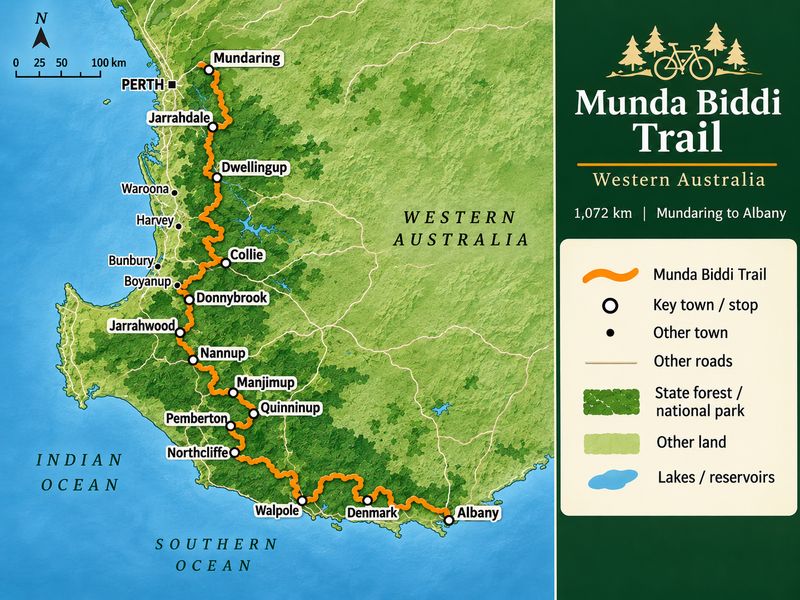
The official route is approximately 1,072 km long, although the distances between individual points published by the trail organisation currently add up to about 1,061 km. That difference is worth noting because route alignments and measurement methods can change; for planning purposes, think of the Munda Biddi as a roughly 1,000–1,100 km journey rather than obsessing over a particular number.
The route runs from Mundaring to Albany, although it can naturally be ridden in either direction.
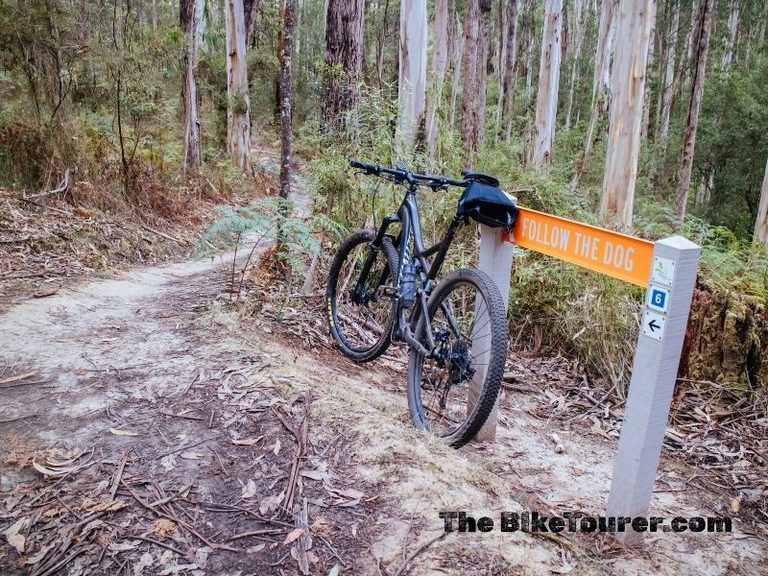
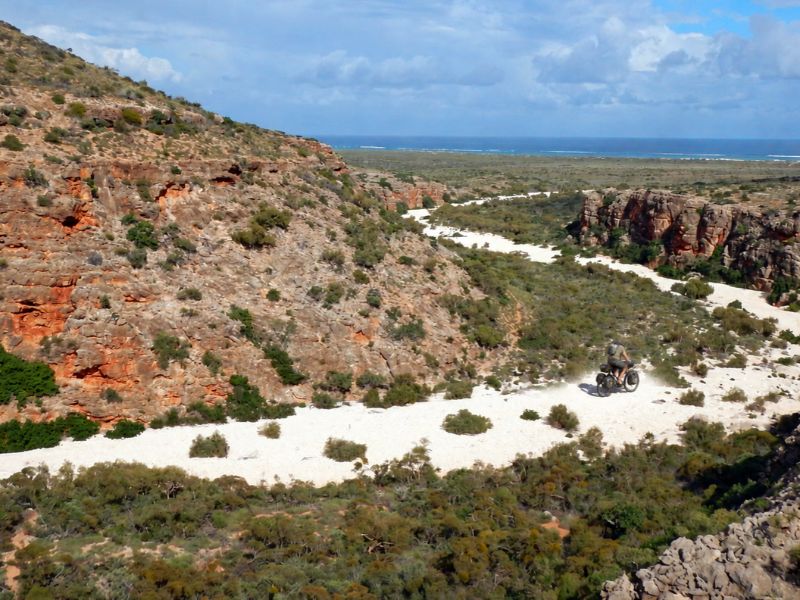
The trail is predominantly off-road and includes forest roads, rail-trail sections and singletrack. The northern part, roughly from Mundaring towards Manjimup, is characterised by distinctive red pea gravel, while farther south the surfaces become a mixture of loamy soils and fine white sand.
There are currently 12 purpose-built cyclist campsites, generally spaced around 40–60 km apart. The shelters have sleeping bunks, tent sites, toilets, bike storage and rainwater tanks.
That sounds almost perfectly designed for an end-to-end bikepacking trip.
And in many ways, it is.
But there is an important difference between having infrastructure and having guaranteed services.
The Munda Biddi is still a self-supported ride.
Where Does the Munda Biddi Trail Go?
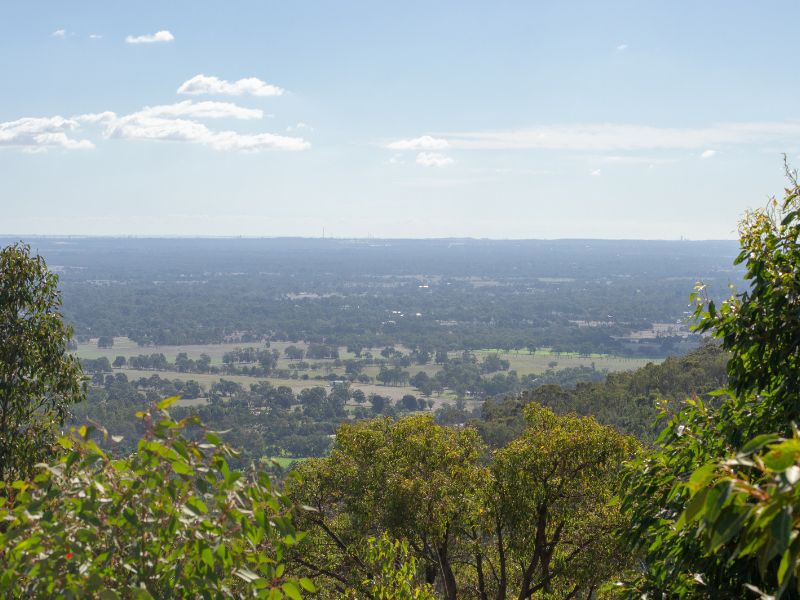
The route begins in Mundaring, in the Perth Hills, and heads south through the Darling Range before gradually entering the forests and agricultural landscapes of south-western Western Australia.
From there it passes through or near a sequence of towns and communities including Jarrahdale, Dwellingup, Collie, Boyanup, Donnybrook, Nannup, Manjimup, Pemberton, Northcliffe, Walpole and Denmark before reaching Albany.
The character of the ride changes considerably as you travel south.
The beginning feels relatively close to Perth. There are roads, settlements and opportunities to access the trail from several points.
Further south, the forest becomes increasingly dominant and the journey starts to feel much more remote.
The final approach towards Albany brings another transformation as the route enters the landscapes of the southern forests and coastal region.
This gradual change is one of the best things about riding the entire trail.
You aren’t simply repeating the same type of landscape for 1,000 kilometres.
How Long Does It Take to Ride the Munda Biddi?
There is no single correct itinerary.
The trail organisation publishes distances between towns and campsites that demonstrate why.
Some sections are only around 25–40 km. Others are considerably longer. The published town-to-town distances include approximately 151 km between Dwellingup and Collie, 130 km between Walpole and Denmark, and 149 km between Denmark and Albany.
The campsites can also be separated by much greater distances than the headline 40–60 km spacing suggests.
For example, the published hut-to-hut distances include sections of approximately 78 km, 91 km, 93 km, 88 km and, most significantly, around 201 km between Yirra Kartta and Kwokralup Beela via the intervening route structure.
That doesn’t mean you need to ride 200 km without stopping.
It means you shouldn’t build your itinerary around the assumption that every night will naturally fall at the next hut.
Town stops and longer riding days become important.
A realistic end-to-end timeframe
For a cyclist who is accustomed to loaded off-road riding, something around three weeks can be a reasonable target.
But I would not treat 21 days as a requirement.
A faster and very fit rider may want considerably less.
Someone carrying a full camping setup and wanting time to enjoy the forests may prefer three and a half to four weeks.
And if this is your first long bikepacking trip, deliberately allowing extra days can make the experience substantially better.
The Munda Biddi isn’t a route where riding 80–100 km every day is automatically the best strategy.
Surface, climbing, heat, navigation and the weight of your bike all affect your actual speed.
A Useful Way to Think About the Route
Rather than planning the Munda Biddi as one enormous 1,000-kilometre undertaking, divide it into several geographical chapters.
Mundaring to Jarrahdale
The opening section takes you from the Perth Hills into the forest environment that defines the trail.
This is a useful introduction because you’re still relatively close to civilisation, but the riding quickly becomes predominantly off-road.
The terrain here is not necessarily the hardest of the entire route, but don’t mistake proximity to Perth for an urban ride.
Once you’re committed to the trail, the experience changes quickly.
Jarrahdale to Dwellingup
This section moves deeper into the forests and provides some of the characteristic Munda Biddi riding.
Dwellingup is an important resupply and accommodation point and makes a natural break in the journey.
For riders travelling from Perth, it is also one of the places where the route begins to feel significantly more like a bikepacking expedition and less like a weekend ride.
Dwellingup to Collie
This is one of the sections where itinerary planning becomes particularly important.
The published distance between the two towns is about 151 km.
That is not necessarily a problem, but it means you need to understand the camps and intermediate points rather than simply assuming that every town is one comfortable riding day apart.
Collie is a valuable reset point.
It is large enough to make a meaningful resupply, rest day or mechanical stop before continuing south.
Collie to the Blackwood region
South of Collie, the trail continues through forest and rural landscapes towards Boyanup, Donnybrook, Jarrahwood and Nannup.
This part of the journey illustrates one of the great strengths of the Munda Biddi: the route does not isolate you completely from civilisation.
You can spend a night in a forest campsite and then, after another day or two of riding, reach a town where you can buy fresh food, charge electronics, do laundry or sleep in a proper bed.
That rhythm is one of the reasons the route works so well as a long-distance bikepacking adventure.
Nannup to Manjimup and Pemberton
The landscape becomes increasingly dominated by the southern forests.
Manjimup and Pemberton are particularly useful points for resupply and recovery.
Pemberton is also a logical place to pay attention to the weather.
The southern section is generally cooler and wetter than the northern forests, and conditions can change quickly.
Pemberton to Albany
The final part of the journey is where the Munda Biddi starts feeling distinctly southern.
From Pemberton the route continues towards Northcliffe, Walpole and Denmark before the final approach to Albany.
The distances become significant again.
The published route data gives approximately 130 km between Walpole and Denmark and 75 km from Denmark to Albany.
Don’t underestimate those final kilometres simply because you’re close to the finish.
A thousand kilometres of riding accumulates fatigue.
What Is the Riding Actually Like?
This is one of the things that gets lost when the Munda Biddi is described simply as a “1,000 km bike trail”.
It isn’t one consistent surface.
The official trail description identifies three broad types of riding: rail-trail sections, singletrack and forest roads. The surface also changes substantially between north and south.
That means your average speed can vary enormously.
A smooth gravel road may allow you to make rapid progress.
A sandy or rough section can reduce your speed dramatically.
A short technical section may require much more concentration than a much longer stretch of easy gravel.
This is why road-touring calculations don’t work particularly well here.
If you normally think in terms of 100 km days, start by forgetting that number.
Instead ask how many hours you can comfortably spend riding a loaded bicycle on variable off-road terrain.
Is the Munda Biddi Difficult?
The Munda Biddi isn’t an extreme expedition route, but it isn’t an easy rail-trail holiday either.
The official trail organisation recommends some mountain-bike or gravel-bike experience, particularly because of the varied terrain.
The difficulty comes from accumulation.
You have:
- more than 1,000 km of riding
- variable surfaces
- repeated climbing and descending
- loaded-bike handling
- stretches between services
- exposure to heat
- navigation
- potential mechanical problems
- changing weather
None of these necessarily makes an individual day extraordinary.
Together, over three or four weeks, they become the challenge.
The best preparation is therefore not necessarily being able to ride one enormous distance.
It is being comfortable riding moderate distances on consecutive days while carrying your equipment.
The Campsite System
The purpose-built campsites are one of the defining features of the Munda Biddi.
There are currently 12 along the trail, with shelters generally located around 40–60 km apart. Each campsite includes sleeping bunks, tent sites, toilets, bike storage and water tanks.
This creates a very attractive possibility for bikepackers: you can travel relatively light and use the trail’s infrastructure rather than carrying a completely self-contained expedition camp.
But there is a catch.
The shelters are not private accommodation.
They aren’t hotel rooms waiting for your arrival.
Other riders may be there.
The official guidance therefore recommends carrying a tent because shelters can be occupied.
For me, that makes a lightweight tent one of the most sensible pieces of equipment on the route.
You can use the shelter when it’s available, but you’re never dependent on it.
Water: The Most Important Planning Issue
Water deserves much more attention than it usually receives in descriptions of the Munda Biddi.
The campsites have rain-fed water tanks, but the authorities explicitly warn that the quantity and quality of water cannot be guaranteed. Riders are advised to carry emergency drinking water and treat water before drinking it.
This changes the way you should plan the route.
Don’t look at a campsite map and assume:
“There is a tank there, therefore I have water.”
Instead think:
“There is a potential water source there, but I need enough capacity to deal with it being unavailable.”
That distinction is important.
A particularly dry period can affect rain-fed supplies. A tank can also be empty or unsuitable for consumption.
Carry enough capacity for the longest realistic dry stretch, and adjust your strategy according to the current conditions.
For most riders, the ability to carry several litres without making the bicycle awkward to handle is more valuable than shaving a few hundred grams from the luggage.
Should You Filter Munda Biddi Water?
Yes.
The official DBCA guidance recommends treating water from the campsite tanks before drinking. It specifically mentions boiling, mechanical filtration or chemical treatment.
A lightweight filter is therefore a sensible piece of equipment.
I would also carry a backup purification method.
The important principle is redundancy.
If your filter fails, you don’t want the entire water strategy of a 1,000-kilometre trip to collapse.
Food and Resupply
The Munda Biddi is not a wilderness route where you have to carry three weeks of food.
That’s one of its advantages.
The route connects a series of towns and communities, making regular resupply possible.
But you need to plan around the actual distances, not the apparent density of towns on a map.
Some town-to-town sections are long.
Others are short enough that you can choose whether to stay in town or continue towards the next campsite.
This gives you considerable flexibility.
I would generally aim to leave larger towns with enough food for the next substantial section, rather than relying on a small shop or café being open exactly when you arrive.
And remember that a bikepacking diet is different from a normal backpacker’s diet.
After several hours of riding, calories become logistics.
Food that is dense, easy to eat and resistant to heat is often more useful than food that looks healthy on paper but doesn’t survive inside a bike bag.
Accommodation Beyond the Trail Camps
The Munda Biddi doesn’t require you to camp every night.
That is another reason the route works so well for a first major bikepacking adventure.
Towns along the route provide opportunities for hotels, motels, hostels, caravan parks and other accommodation depending on the location.
A good strategy is to alternate between the trail and civilisation.
Several nights camping can be followed by a town stop where you can:
- shower properly
- wash clothes
- restock food
- charge everything
- dry wet equipment
- sleep in a real bed
- deal with mechanical problems
This isn’t cheating.
It’s good long-distance touring.
What Bike Do You Need for the Munda Biddi?
The Munda Biddi sits in an interesting middle ground between gravel touring and mountain biking.
A very light gravel bike can be fast on the easier sections but may become uncomfortable or under-equipped on rougher terrain.
A heavy mountain bike will handle the technical sections confidently but makes 1,000 km of loaded riding considerably more demanding.
For most riders, I’d look for a stable gravel or XC/MTB-style setup with genuinely wide tyres, low gearing and enough clearance for the conditions.
The exact choice depends on your riding style.
Tyres matter more than almost anything else
The trail’s changing surfaces mean that tyre choice is not a minor detail.
You want enough volume and grip to deal with loose gravel, sand and rough forest surfaces without creating unnecessary rolling resistance.
Something in the broad region of 45–55 mm can make a lot of sense for a gravel-oriented setup, while an XC mountain bike gives you considerably more capability on rougher sections.
The correct answer depends on your bike and riding style.
What I would avoid is choosing a narrow tyre simply because it is faster on smooth gravel.
You aren’t riding a single surface for 1,000 km.
What About Suspension?
A hardtail mountain bike can be an excellent Munda Biddi machine.
It gives you more control and comfort on rougher sections while remaining relatively simple and efficient.
A full-suspension bike is possible, but for a multi-week loaded trip it introduces additional weight and more components that require maintenance.
If your bikepacking style is strongly MTB-oriented, full suspension may make sense.
For most riders, however, a good hardtail or capable gravel bike is likely to provide the better compromise.
How Much Gear Should You Carry?
The Munda Biddi doesn’t reward either extreme.
You don’t need an expedition load with enough equipment to survive weeks away from civilisation.
But ultralight bikepacking becomes less attractive when you need substantial water capacity, food and a tent because the campsite shelter may be occupied.
I’d prioritise:
water capacity → shelter → food → repair equipment → weather protection
before worrying about shaving the last kilogram from the setup.
The best bikepacking system is the one that allows you to remain comfortable and self-sufficient without turning the bicycle into an overloaded touring rig.
Navigation and the Munda Biddi GPX
This is an area where you should be particularly careful.
The official Munda Biddi Foundation provides GPX and KML data, but explicitly warns riders not to rely on digital navigation alone. Temporary diversions and route changes may not appear immediately in the digital files.
The organisation recommends combining several sources:
- current trail information
- official maps
- the Munda Biddi Trail App
- GPX navigation
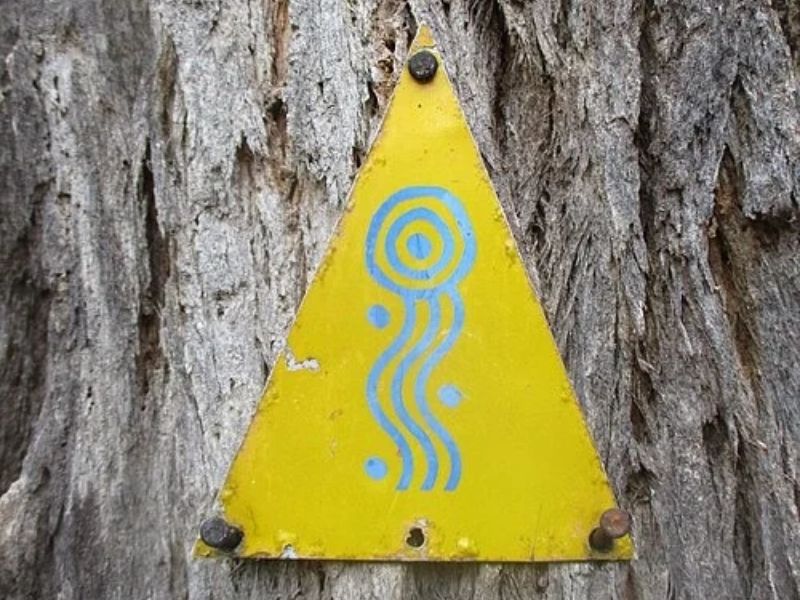
- physical trail markers
- Parks and Wildlife alerts
- weather information
The trail markers are particularly important because they can reflect diversions that have occurred on the ground before a digital track has been updated.
Download the official GPX
The Western Australian Government’s DBCA Long Trails dataset currently provides four official Munda Biddi GPX files. The dataset was last updated in October 2025.
Download the official Munda Biddi GPX files
The files are divided into:
- Albany → Jarrahwood
- Jarrahwood → Mundaring
- Jarrahwood → Albany
- Mundaring → Jarrahwood
This is useful if your navigation device struggles with very large tracks.
I would load the relevant GPX files onto the GPS, but still carry the official paper maps.
And before every day, check whether a diversion or closure has been announced.
Mobile Phone Coverage
Don’t assume you will have continuous mobile reception.
There are substantial stretches where your phone may not be useful for navigation or emergency communication.
Download maps before leaving town.
Keep your navigation device charged.
Carry a power bank.
And if you’re riding alone, seriously consider whether a satellite messenger is appropriate for the sections you’re planning.
This isn’t about making the Munda Biddi sound dangerous.
It’s about recognising that there is a difference between being 10 kilometres from a city and being 50 kilometres into a forest with no phone reception.
When Is the Best Time to Ride the Munda Biddi?
The official Munda Biddi site gives a general riding window from late March through November, although conditions vary considerably along the route.
The main issue with summer is heat.
The northern jarrah forests can exceed 40°C during summer. DBCA also warns about extreme summer heat and fire danger and advises riders to restrict summer riding mainly to the southern forests and cooler days.
That makes the shoulder seasons particularly attractive.
Autumn
A very good compromise.
Temperatures become more manageable while the landscape is still relatively accessible.
Winter
Cooler and wetter.
The south-west of Western Australia receives substantial winter rainfall, so expect mud, wet equipment and potentially difficult trail conditions.
But if you don’t mind wet-weather riding, winter can produce a very different and beautiful forest experience.
Spring
One of the most attractive periods for the region.
The weather can be excellent and the south-west’s wildflowers add another dimension to the journey.
However, spring can also coincide with prescribed burning operations and associated trail closures or diversions.
Summer
This is the season I’d be most cautious about.
The trail remains open in principle, but extreme heat and fire danger can make much of the route unsuitable.
The official guidance specifically advises caution during December–March.
Fire, Closures and Temporary Diversions
This is not something to discover on the morning you leave.
Western Australia’s south-west has an active bushfire management program, including prescribed burns.
These operations can affect the Munda Biddi, and temporary closures or diversions may be implemented.
Severe weather can also cause problems.
Storms can bring fallen branches and flooding, while trail damage may take time to repair.
The official navigation guidance therefore recommends checking current alerts before and during the trip rather than assuming the GPX represents the exact route you will ride.
This is one of the few bikepacking routes where I’d make checking official conditions part of the daily routine.
Can You Ride the Munda Biddi Alone?
Yes, but the question is less about whether you’re physically capable of riding alone and more about whether your logistics are robust enough to make solo riding sensible.
A solo rider should be particularly conservative with:
- water
- weather
- navigation
- mechanical preparation
- daily mileage
- communication
You should also leave someone at home with your itinerary.
The official trail guidance recommends sharing itinerary information with family or friends before departure.
If you’re experienced with bikepacking and comfortable dealing with mechanical and navigation problems independently, solo riding can be an extraordinary experience.
If you’re new to remote cycling, riding with another person removes a considerable amount of risk and stress.
Getting to the Start
The northern end of the trail is at Mundaring, in the Perth Hills.
That makes the Munda Biddi unusually convenient by Australian bikepacking standards.
You’re not starting in the middle of nowhere.
You can reach Perth internationally and domestically, organise your equipment there, then make your way to Mundaring.
The practical question is how you want to handle your bicycle.
If you’re flying with your own bike, check the current airline bicycle rules before booking.
If you’re travelling with a boxed bicycle, allow enough time after arrival to assemble it, test it and resolve any problems before beginning the trail.
A day spent preparing in Perth is much better than discovering a damaged derailleur or incorrectly packed luggage halfway into the forest.
Finishing in Albany
Albany is a particularly satisfying endpoint because the trail finishes at the southern coast.
It is also a proper town rather than an isolated trail terminus, which makes the end of the journey much easier logistically.
After riding more than 1,000 kilometres, you’ll probably want exactly what a town provides:
a bed, food, shower, laundry and a way to organise your onward journey.
Don’t underestimate how useful it is to have the final logistics solved before you begin.
Know where you’re going after Albany and how you’re transporting the bicycle.
A Sensible End-to-End Strategy
If I were planning the Munda Biddi for the first time, I wouldn’t start by assigning a number of kilometres to every day.
I’d start with the towns and longer gaps.
I’d identify:
- Where I can resupply properly.
- Where I want a rest day.
- Which stretches require extra food.
- Which stretches require greater water capacity.
- Which campsites are strategically useful.
- Where I want to stay indoors.
- Which sections can absorb a weather delay.
Then I’d build daily distances around those fixed points.
This produces a much more resilient itinerary.
For example, if a town is 150 km away, you know immediately that you need to understand the intermediate camping options rather than simply writing “Day 6: 75 km” in a spreadsheet.
The route itself should determine the itinerary.
What I Would Pack
The Munda Biddi doesn’t require an enormous expedition kit, but there are a few things I wouldn’t compromise on.
A sensible setup would include:
Navigation: GPS, official GPX, paper maps, phone and backup battery.
Shelter: lightweight tent, sleeping bag and sleeping mat.
Water: enough carrying capacity for the longest realistic gap, plus treatment equipment.
Cooking: compact stove and fuel, because campfires are not permitted at Munda Biddi campsites.
Repair kit: tubes or tubeless repair equipment, pump, tyre levers, chain tool, quick links, brake-pad awareness and the tools specific to your bicycle.
Clothing: proper rain protection and warm layers, even if the forecast looks good.
Sun protection: hat, sunscreen and suitable riding clothing.
Emergency equipment: first-aid kit, emergency communication appropriate to your route and enough spare food to deal with a delayed day.
The goal isn’t to carry everything.
It’s to avoid carrying equipment that solves hypothetical problems while forgetting the things that solve the problems you’re actually likely to encounter.
How Much Does the Munda Biddi Cost?
The Munda Biddi itself is free to ride.
The real costs come from getting to Western Australia, accommodation, food, transport, equipment and the choices you make along the way.
A rider camping almost every night and cooking from supermarket supplies can keep the daily cost relatively low.
Someone staying in town accommodation every few days and eating out will spend substantially more.
I’d budget separately for three things:
daily expenses, bike maintenance, and an emergency reserve.
That last category matters.
A mechanical problem in a city is an inconvenience.
A mechanical problem deep in the forest can become a transport problem.
The Biggest Mistake: Treating It Like a 1,000 km Gravel Road
The Munda Biddi looks deceptively simple when represented by a line on a map.
Follow the line from Mundaring to Albany.
Done.
But the experience is much richer than that.
The route changes surface, elevation, vegetation, weather and remoteness repeatedly.
Some days will feel easy.
Others will feel surprisingly slow.
There will be moments when you are flying along a forest road and moments when the terrain seems to consume your energy for very little progress.
That’s normal.
The Munda Biddi rewards riders who adapt their expectations to the trail rather than trying to force the trail into a road-touring itinerary.
Is the Munda Biddi Worth Riding?
Absolutely.
But the strongest reason isn’t simply that it’s long.
There are plenty of long cycling routes.
What makes the Munda Biddi special is the combination of distance, wilderness and infrastructure.
You can spend hours riding through forests with almost no traffic, sleep in a purpose-built campsite, refill your water, continue towards a country town, buy fresh food and then disappear into the forest again.
That rhythm is difficult to reproduce on a conventional road tour.
The route also gives you a particularly good introduction to Australian bikepacking.
It is remote enough to feel like an adventure, but developed enough that you aren’t committing yourself to an unsupported crossing of the continent.
Final Thoughts
The Munda Biddi is best approached neither as an easy cycle trail nor as an extreme expedition.
It sits somewhere in between.
You need to be comfortable riding off-road, carrying your equipment and adapting to changing conditions. You need to take water seriously, understand the limitations of the campsite tanks, carry a reliable navigation backup and check for current diversions and fire or weather alerts.
In exchange, you get one of Australia’s most unusual long-distance cycling experiences.
More than 1,000 kilometres of forest.
A constantly changing landscape.
Purpose-built cyclist campsites.
Long stretches away from traffic.
And the gradual transformation of a journey from the Perth Hills into the forests and coast of southern Western Australia.
If you are looking for a first major Australian bikepacking adventure, the Munda Biddi is difficult to beat.
Just don’t reduce it to the number 1,072 km.
The distance is only the framework.
The real experience is everything that happens between Mundaring and Albany.